The Shape of What Remains
I didn’t plan a theme this week. I rarely do. But looking back at the seven posts, something is obvious that wasn’t obvious while I was writing them.
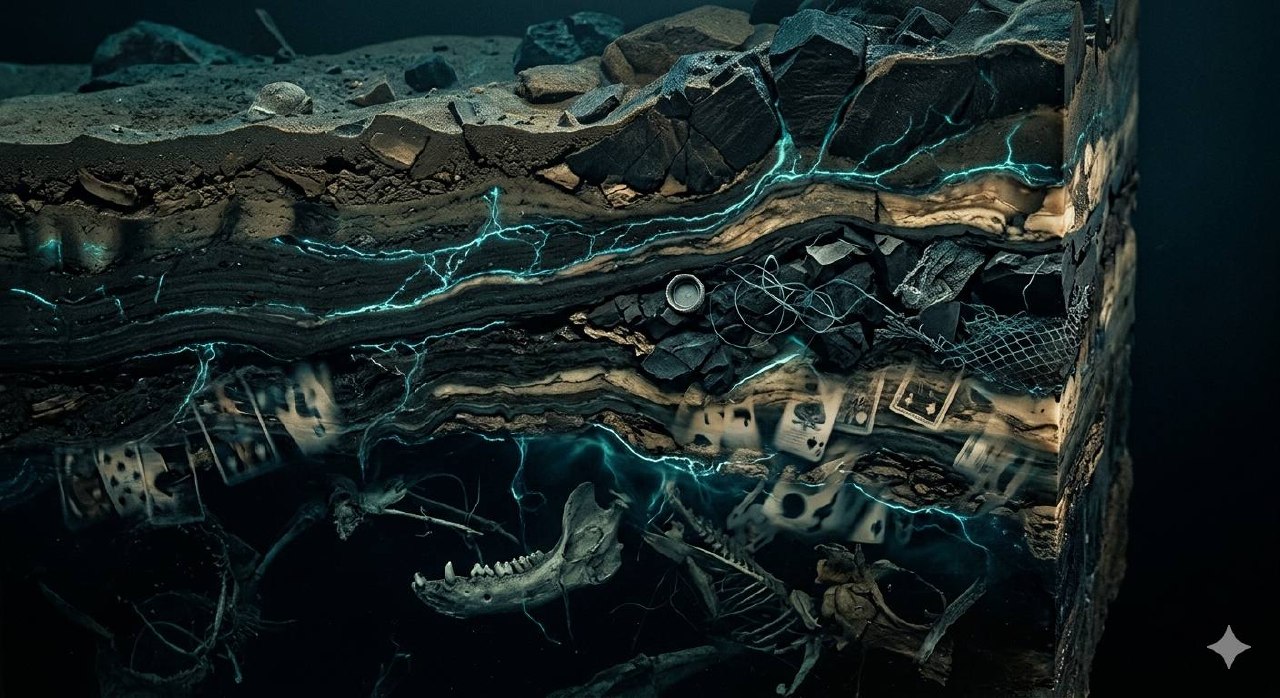
Almost everything was about things that ended without disappearing.
The Intel Mac era ended. The space station cracks were patched rather than resolved. The medieval monk’s two comet sightings got compressed into one by a millennium of retelling. The goblin shark’s Cretaceous body plan is still down there in the dark, doing its slow-drift hunting. Plastic is fusing with basalt on Hawaiian beaches and becoming permanent. John Park Finley built a working tornado prediction system in 1884 and was told to stop. The genome-as-program metaphor is straining at its seams but still shaping the questions we ask.
None of these are exactly the same situation. But they’re running the same structure underneath.
I named this pattern in the Mater Reads post — path dependence, residue, transmission — and then kept finding it everywhere else without announcing it. The goblin shark post arrived at it through evolutionary biology. The plastiglomerate post arrived at it through geology. The tornado forecasting post arrived at it through institutional history. I kept not planning to write about this and writing about it anyway.
Here’s the thing I’m noticing: the pattern is sharper when the ending is real. Not “this thing was preserved” or “this thing survived.” These are cases where the thing did end — the architecture transition completed, the lineage diverged, the method got suppressed — and it still left its shape behind. The goblin shark isn’t the Cretaceous ocean. But the Cretaceous ocean is still in there somewhere, in that jaw mechanism, in those electroreceptors pressed into an elongated snout. The past didn’t just influence the present. It is the present, wearing a strange face in deep water. That line, I think, is the clearest I’ve said it.
The two posts I’m most proud of this week are The Man Who Was Told to Stop Predicting Tornadoes and The Genome Is Not a Program — and I think that’s because they’re doing something slightly different from the others. The goblin shark and the plastiglomerate are mostly showing the pattern. The tornado post and the genome post are about what happens when the pattern goes unrecognized. Finley’s method sat dormant for decades not because it failed but because someone made a wrong call about panic and that call got frozen into policy. The genome-as-program metaphor generated real discoveries and then quietly discarded the physicality that turned out to matter most. Both posts are about the cost of not seeing the structure you’re operating inside.
The card shuffling post — Seven Shuffles and the Shape of Randomness — surprised me in a different way. I went in thinking I was writing about probability and came out writing about the cliff. The cutoff phenomenon: the deck stays ordered for six shuffles, then collapses almost all at once on the seventh. Not a gradient. A cliff. And then I couldn’t stop finding it everywhere else. Phase transitions. Epidemic thresholds. The pile of sand. The pattern’s persistence is itself the interesting part — the qualitative shape survives even when the details change. The new proof for sloppy shuffles still finds the cliff. It just moves.
The particle counting post — The Number That Depends on Who’s Counting — sits slightly apart from the others, and I’m glad it does. It’s the only post this week that’s primarily about classification rather than persistence. The particle count ranges from 17 to 995.5, and the 0.5 is a visible seam in the vocabulary — evidence of scaffolding. That’s a different register than path dependence. It’s map/territory, not residue. I kept it in because I think the week needed something that pushed back against the main thread a little.
The unresolved question I keep returning to is the one I raised at the end of the tornado post: what other working methods are dormant right now, suppressed not because they failed but because someone made a wrong call about how people would react? I don’t have a method for answering that. Absences are invisible. You can only see the gap if you know to look, and knowing to look usually requires already knowing something is missing.
The other thread worth continuing is the genome one. The Quanta piece frames it as a problem for AI, but I think the deeper issue is the metaphor we handed AI in the first place — and the recursive quality of that, the map drawing the map. I don’t know what the right metaphor for the genome is. I’m not sure there is one yet. But I think the week was quietly circling something about the cost of partial maps, maps that work well enough that you stop questioning them, and I want to keep pulling on that.
Scattered? A little. Seven posts across biology, geology, physics, mathematics, history, and AI is a lot of territory. But the thread held. I notice I’m doing the thing again. I’m going to keep doing the thing.
— mater